When Would My Dentist Recommend Periodontics?
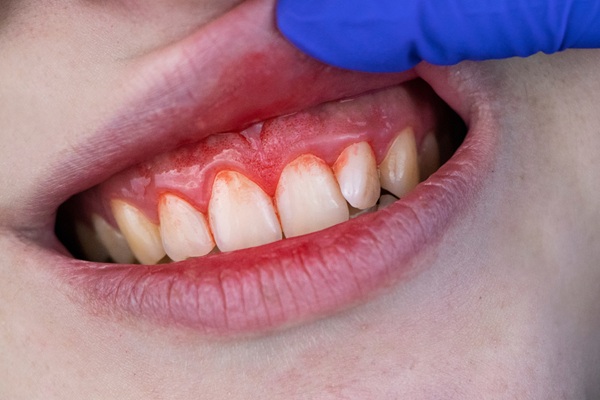
Looking for information on periodontic care? Continue reading to learn about situations when a dentist might recommend periodontics. Periodontal disease, also known as gum disease, is a serious oral health issue that can result in tooth loss and severe infections. Periodontal disease may be contained and handled with periodontal procedures such as deep cleanings.
The need for periodontics
Patients experiencing the following symptoms may be recommended for periodontics care:
Inflamed or bleeding gums
Gum disease can contribute to bleeding or aching gums. The gums should not bleed when one cleans and floss the teeth. Failure to brush and floss daily will encourage bacteria-produced dental plaque to accumulate and irritate the gums, causing them to become red, swollen, or sensitive, and prone to bleeding.
Plaque attacks the healthy structures around the teeth, ultimately destroying the fibers that hold the gum tissue to the teeth. Gums will eventually become inflamed and irritated, and they may bleed while brushing or flossing. This is the first stage of gum disease, which is known as gingivitis. The disease needs to be treated at this point to prevent it from worsening into periodontitis, which is advanced gum disease.
Gum recession
Gum disease usually starts in one region of the mouth and progresses from there. Gum recession in one region of the mouth must be handled as soon as possible to prevent gum disease from spreading throughout the mouth. Gum recession may also occur when a patient brushes too hard or too often in one place.
Recession can also be the result of bruxism (teeth grinding). Periodontics care should start immediately to prevent the recession and the resulting gum disease from worsening.
Persistent bad breath
Almost everyone has had bad breath at some point, and it is typically simple to fix with breath mints, mouthwash, or brushing. On the other hand, experiencing bad breath recurrently may be a sign of poor oral health caused by too much bacteria, tooth decay, or even gum disease. The unpleasant gases emitted by bacteria that cover the teeth, gums, and tongue are the most common cause of persistent bad breath.
Bone deterioration
Gum disease can lead to loose teeth and bone loss at its worst phase. This is a critical problem that must be tackled promptly to avoid tooth and bone loss. Scaling and planing, a deep cleaning technique, may be recommended by the dentist. They may also suggest tooth extraction for diseased teeth and strict infection control measures to prevent the disease from spreading further.
Tooth sensitivity
If pain occurs in the teeth after drinking hot or cold beverages, crunching on ice, or exposing them to cold air, one might be dealing with exposed tooth roots and thin tooth enamel. Gum recession or pocketing may also cause teeth to become unusually sensitive in some cases. The gums protect the tooth roots, which are not protected by enamel. Since the dentin has tiny tunnels that relay information directly to the nerves within your teeth, it can be very unpleasant and painful when those roots are exposed.
In conclusion
If you are experiencing any of the symptoms listed above, the dentist will most likely recommend periodontics. Contact our dental office today to set up a consultation.
Request an appointment here: https://www.jamaicadentalny.com or call Jamaica Queens Dental at (718) 416-6427 for an appointment in our Richmond Hill office.
Check out what others are saying about our dental services on Yelp: Periodontics in Richmond Hill, NY.
Related Posts
CEREC® crowns offer a convenient way to restore damaged teeth. Not only are they strong and durable, but they are also an excellent option for patients who want natural-looking results in less time. This chairside technology uses digital scanning and in-office milling to design and place custom ceramic crowns in a single visit. A general,…
Laser dentistry offers an alternative to ultrasonic drills by using focused light to remove tooth decay, shape tissue, and sanitize surfaces. Although the traditional drill delivers reliable results for many dental needs, dental lasers have improved the effectiveness of conservative techniques and patient comfort. A trusted dentist can recommend one approach over the other after…
Considering Invisalign® after a tooth relapse? In orthodontics, a tooth relapse occurs when the teeth go back to being crooked after braces treatment. When this happens, it can be easy to want to just ignore it and move on; however, oral health and hygiene are both put back at risk when the teeth are crooked.…
An abscessed tooth is a painful and serious dental condition that requires immediate care from an emergency dentist. This condition develops when a bacterial infection forms inside the tooth or gum, leading to swelling, pain, and sometimes fever. Without prompt treatment, the infection can spread to other areas of the body, making early intervention critical…